Showing posts with label Hashimoto. Show all posts

Tuesday, March 7, 2017

Hashimoto, The Great Canadian Japanese Kaiseki Restaurant

Chef Masaki Hashimoto was one of the top 5 winners in a competition of kaiseki chefs in Japan, in 2008. Your experience at Hashimoto will best exemplify his talents.

Every element of the cuisine that we experienced at Hashimoto was flown in fresh from Japan. The rarer the item or greater the provenance, the more costly, especially as the fresh fish is in the resto within about 30 hours out of the water from Japan. 


Frankly, having experienced many of the greatest restaurants in Japan, over the years, I find the rarified level of experience at Hashimoto to be one of the closest in North America to what one can experience in Japan at some of their very best restos. Further, as compared to any other Canadian Japanese resto, Hashimoto is at another level. Not more than about 6 North American Japanese restaurants reach this height. 


If you are an experienced Japanese cuisine aficionado and can appreciate the more subtle elements, if you are prepared to give the chef a free hand in getting the very best of what is available and are prepared to pay for this kind of service and quality, give Kei Hashimoto, the son of the owner/chef enough advance notice, and a dream meal will follow, especially if you have eaten there before and he knows you well. You will probably have the very small resto virtually to yourselves and the complete attention of kei and the chef. Yes, in comparison to your North American experiences this level of experience will be very expensive, but I guaranty that the experience will be a truly unique gustatory pleasure and the expense reflective of the best of Japan and the cost of getting the Japanese food elements to Toronto very quickly, from the best sources.


Of course, there are various other levels of experience at Hashimoto that are less expensive. The cost of the meal will depend on your choice. But whatever level of experience you choose, it will be indeed unforgettable. With Kaiseki cuisine, there is no menu. The dishes presented will depend of the level of experience you choose (cost) and the season.


Our first bottle of sake: Daiginjo Shizuku Sake, Jyuhachidai Ehei, from Fukushima prefecture.

This is a drip filtered Daiginjo sake representing the 18th Generation Brew Master, calling it Ihei. Okunomatsu Shuzo company established in 1716 just celebrated their 300th year anniversary.


Zensai

Steamed sea urchin (uni), sea urchin sashimi, sesame tofu. This sea urchin was "super premium" (goku goku jyo) from nemuro-shi, Hokkaido, Japan!


Sashimi-1


Tennen madai (fresh Japanese red sea bream from Fukuoka, Kyushu, Japan) and madai blanched skin, hand cut daikon and freshly grated wasabe. All served on a 250 year old imari-yaki plate.


Owan-mono (Soup)


Shirako (fresh cod sperm from Nemuro-shi, Hokkaido, Japan) charred, Uguisuna (petit turnip) with yuzu strips, broth made from madai (Japanese red sea bream), grated kabu (turnip) and kuzu starch. 


Yaki-mono - 1 (Grilled)


Fresh ise-ebi (spiny lobster from Ooita, Kyushu, Japan).


Grilled spiny lobster tail with miso and baked head accompanied by palate cleansers of lotus root, hand cut daikon and carrot.


Sashimi-2


Raw spiny lobster, lightly blanched on the bottom and raw at the top, served on a 300 year old Utsu Tsu-Yaki plate.
.

Taki Awase (Steamed and Stewed)


Amadai (tile fish from Fukuoka, Kyushu, Japan), steamed with kombu (sea kelp), grated turnip and drizzled with ponzu sauce, accompanied by snow peas, plum flavoured carrot and yuzu strips.


Sashimi-3

Fresh okoze (stone fish from Ooita, Kyushu, Japan).


Stone fish sashimi served with boiled stonefish liver, accompanied by ponzu sauce, grated daikon with red peppers and green onion.


Agemono (Fried)


Fried stone fish fin and head served with ponzu sauce.

Yaki-mono-2 (Grilled)


Unagi (Japanese freshwater eel from Kagoshima, Kyushu, Japan), grilled and topped with either salt with wasabe and sansho pepper or with with house made teriyaki sauce.

Shii-zakana (Extra dish)


Live kegani (Horsehair crab) from Hokkaido, Japan.


Barely poached kegani crab legs served with wari-zu (sweet vinegar sauce).


Hokkaido Hairy Crab enjoyed Shabu shabu style, with a light soy vinegar sauce. Using a Binchotan burner, the crab was enjoyed either lightly blanched or fully boiled to one's liking, in Konbu water. 

Signature dish


Charred A-5 ribeye Juoshu wagyu beef from Gunma prefecture, Japan, served with macha sea salt, signature, hand carved daikon crane, with a carrot dressing (white cup) and all accompanied by palate cleansers of Japanese green plum and sweet kumquat.


The provenance certificate of the beef.


Tomi-zen (Main)


Kegani (horsehair crab) rice topped with hand cut fried ginger and accompanied by spiny lobster miso soup with egg tofu and mizuna, 5-day stewed pork belly with hot mustard and also arrow root, gobo root, yama imo (Japanese mountain yam) and sato imo (Japanese taro root) all simmered in turnip leaves and stems.
Mizu-mono (Dessert)


Strawberry, pear with edible gold flakes, Japanese style pudding, Matcha crepe with cream, house made ice cream: strawberry, vanilla, matcha and hojicha (a form of Japanese green tea), all served on a 70 year old Arita-yaki (Kaki Uemon) plate.

Enjoying the tea ceremony after our dinner, in a private room.

As I mentioned, overall, quite an extraordinary experience!

Monday, February 3, 2014

Hashimoto, One of North America's Great Kaiseki Experiences

This special kaiseki meal was catered to our special requests. Unless otherwise stated, all dishes are sashimi and the sauces are house made.

Onjykuzen:
 Presentation.


Shirako (fish sperm) on top of egg tofu made with shirako and topped off with chopped green onions in a sauce of soy and ponzu mixed with starch. White rice topped with rice cracker. Arrow root vegetable sits in white miso (Kyoto saikyo) combined with dashi from kegani (horse hair crab).

Mokozuke:
Madai (red sea bream), thinly cut, skin lightly boiled, with bakudai (seed) jelly made with agar agar accompanied by freshly grated wasabi flown in from Japan, and house made soy sauce. Dish is Utsutsugawa and is 300 years old!!


Amadai (tile fish), lightly grilled on the skin and topped with this fish's deep fried, delicately crispy scales, accompanied by freshly grated Japanese wasabi. The dish is Imari (Musubi-Akae) and is 200 years old. The shape resembles a tie, symbolizing a good long relationship.


A presentation of uni (sea urchin).


An uni tasting, fresh uni in it's shell, on the left, and uni that has been harvested in the conventional way for Japanese restaurants, that was topped with mountain potato and kintoki ninjin (Japanese carrot) cut onto a flower petal. 


Raw horse hair crab, served with flavoured, very hot water to dip and partially cook the meat and a dipping sauce.


Mark Hashimoto about to open an important bottle of saki.


Wanmono:
Presentation.


Madai, mountain potato, domyoji (sweet rice coloured pink with with sour plum), kabu (turnip), kintoki ninjin (Japanese carrot), mizuna (greens), yuzu (citrus) all in a yuzu broth combined with grated kabu.


The presentation of the 3 kinds of exceptionally marbled beef, especially imported for us from Japan, that will make up our beef tasting.


The presentation.


Yakimono:
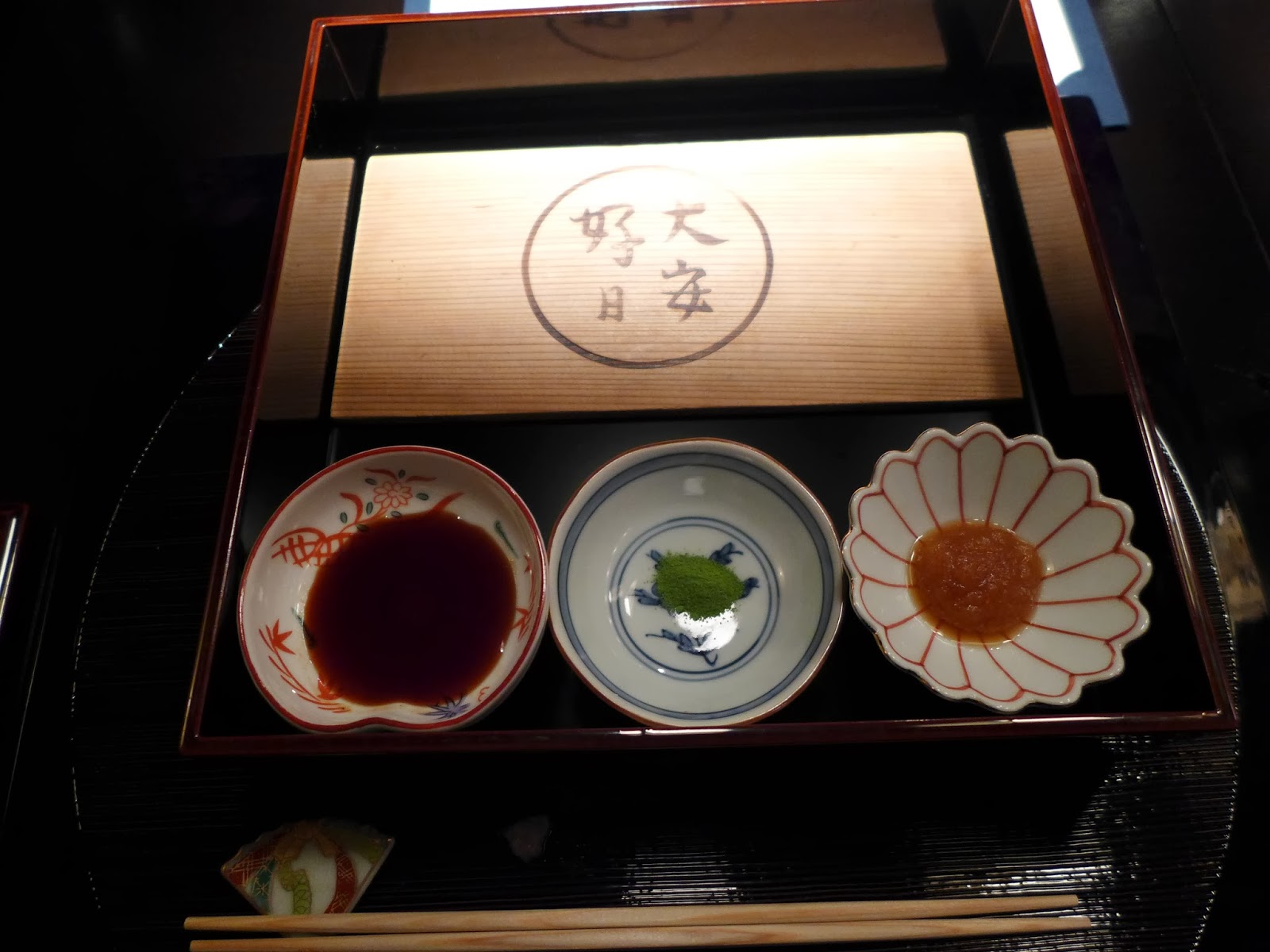
The 3 condiments for our beef tasting, on the left, homemade teriyaki, matcha tea/sea salt ground together into a fine powder (my favourite) and grated daikon with soy sauce.


The presentation of A3 wagyu strip loin from Kagoshima prefecture, Japan.


The presentation of A4 wagyu rib eye from Gunma prefecture, Japan, accompanied by long cooked yam.


The very best quality A5 wagyu rib eye from Gunma prefecture, Japan.


The special presentation of the 300 year old ceramic vessel Oribe Tsutsu.


In the above vessel, A5 wagyu tossed with ponzu sauce topped with grated daikon and chopped green onion.


Takiawase:
The presentation.

Aka-mutsu with kabu, strip green beans, and kintoki ninjin (Japanese carrot) carved into a flower.


The presentation.


Madai wrapped with konbu (kelp) and steamed, accompanied by shiitake mushrooms, steamed sliced yuzu and ponzu sauce.


Shiizakana ( have photographed different perspectives):


The over all presentation with the chef's hand carved crane made of daikon (and eaten). Kuruma ebi (shrimp) tempura. Chefs carrot dressing to be eaten with the crane, on the left. On top right are roasted puffed rice on their stem, that we enjoyed pulling off and eating like popcorn.


From the above presentation, sweet black beans with sweet vinegared chorogi root (in the artichoke family).
Tomezen:
The presentation.


Uncovering the bowl on right.


Pickles of cucumber, daikon marinated with koji mold, thinly cut pickled kabu and sweet and sour vinegared daikon with carrot.


Hot pot with kegani, nappa (cabbage), mizuna and nama-fu (soft gluten).


Kegani rice in head shell topped with julienned ginger strips.


Kanmi:
Presentation.


House made vanilla ice cream with red wine sorbet, pear marinated with red wine, matcha (green tea) mousse and strawberry jelly (made with agar agar) with strawberries, topped with gold leaf.


We then moved into the tatami mat coverd room to enjoy the tea ceremony.


Some of the tea ceremony untensils.